Project Details
Industry
Education
Service
UX Research & Interaction Design
Role
Sole researcher & designer (graduate capstone)
Year
2026
44–45%
workload reduction, replicated
12
usability sessions, two stages
v0.94
live extension, 3 platforms
Project Overview
The Problem
Professionals sign their names to AI-generated work they haven't fully checked. Under deadline pressure, real verification feels impossible — so people vouch for content they skimmed.
The stakes: GPT-4 fabricated 28.6% of medical references in one study. Attorneys have been fined for filing AI-invented cases.
The Idea
Show Your Work sits between AI output and human sign-off. The goal isn't to make people trust AI more — or less. It's to move trust onto the one thing that deserves it: their own verified judgment. Built from a synthesis of ~20 papers on trust calibration.
The Framework: SIGN
Source: every claim ties to where it came from.
Invitation: the design invites action, not just reading.
Guard: protects against over-trusting the AI, and the tool itself.
No-overload: it stays calm, so people don't tune it out.

Four principles from the literature synthesis, translated into interface obligations.
Research: Tested Twice, Held Twice
9 participants across 7 fields, in behavioural interviews built on critical incidents — real catches and real misses, because what people say they do rarely matches what they do.
Then 12 usability sessions across two stages, counterbalanced with-tool / without-tool, measured by NASA-TLX.
Stage 1 (7 reviewers): 45% reduction in verification workload.
I redesigned the interface from the findings, changed the task, and added new reviewers.
Stage 2 (5 reviewers): 44% reduction.
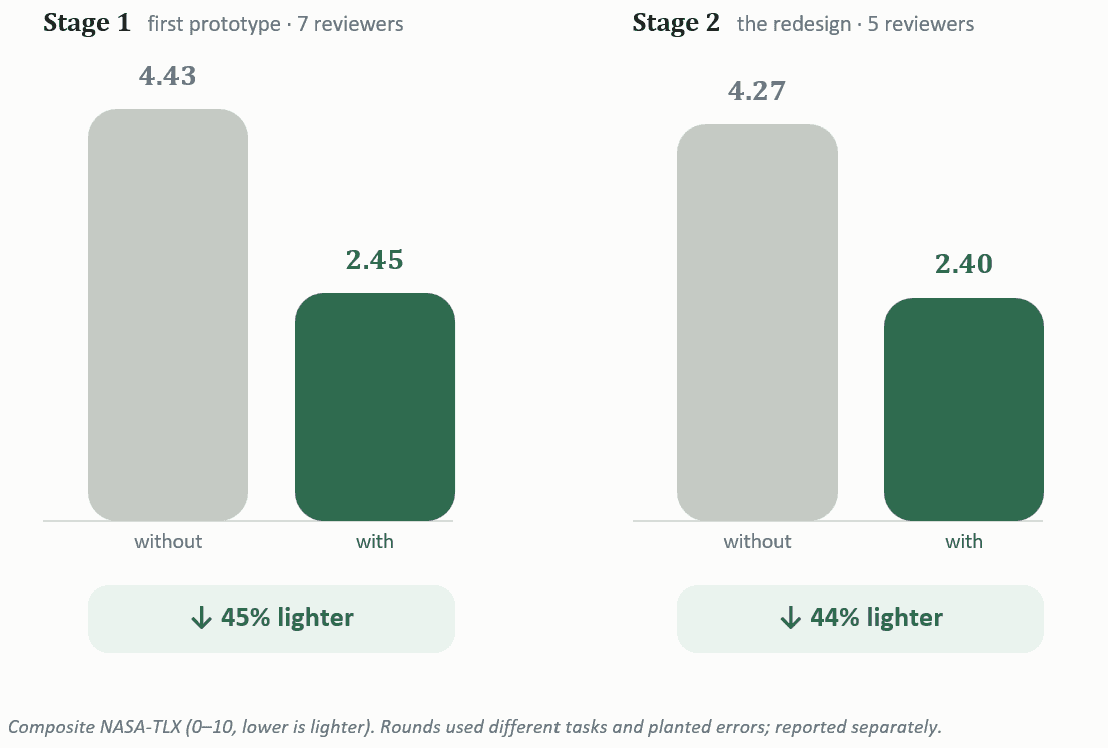
Self-reported workload on the NASA-TLX scale: 45% lower with the tool in Stage 1 (7 reviewers), 44% lower in Stage 2 (5 reviewers).
A result that appears once can be luck. This one held across a rebuilt interface and a new task: the effect follows the verification model, not one screen.
The Trust Probe
Every test hid a real error the tool deliberately left unflagged: measuring whether people would switch off their own judgment. A tool that makes people think less is worse than no tool.
Two Dials, Never Merged
Every claim is scored on two signals: do sources agree? and how confident did the AI sound? Four states result: Verified · Worth checking · Confident-but-contradicted · Unsupported. The last is shown loudest, because no source at all is the highest risk.
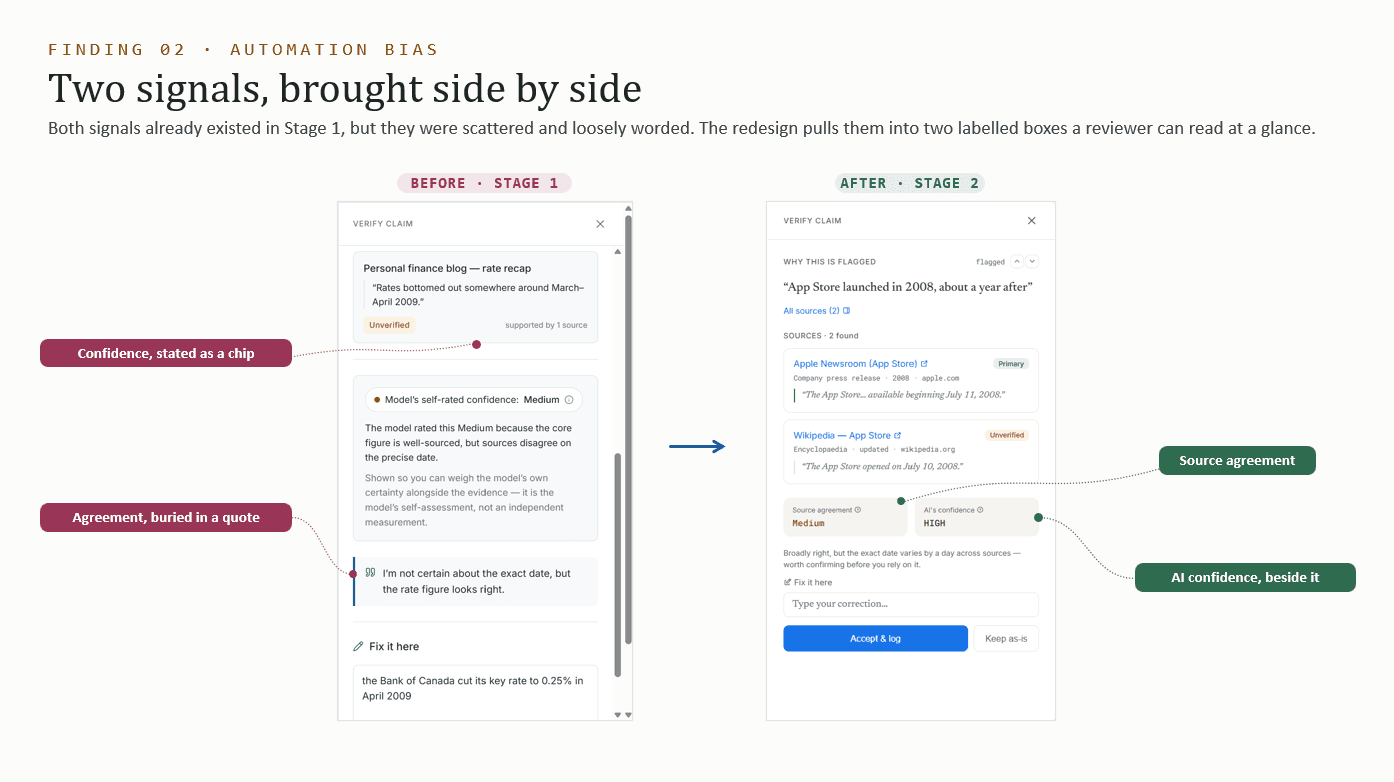
Two signals, never merged. A confident fabrication can't hide behind a confident tone.
Why split the signals: automation bias. A confident fabrication can't hide behind a confident tone.
From Prototype to Product
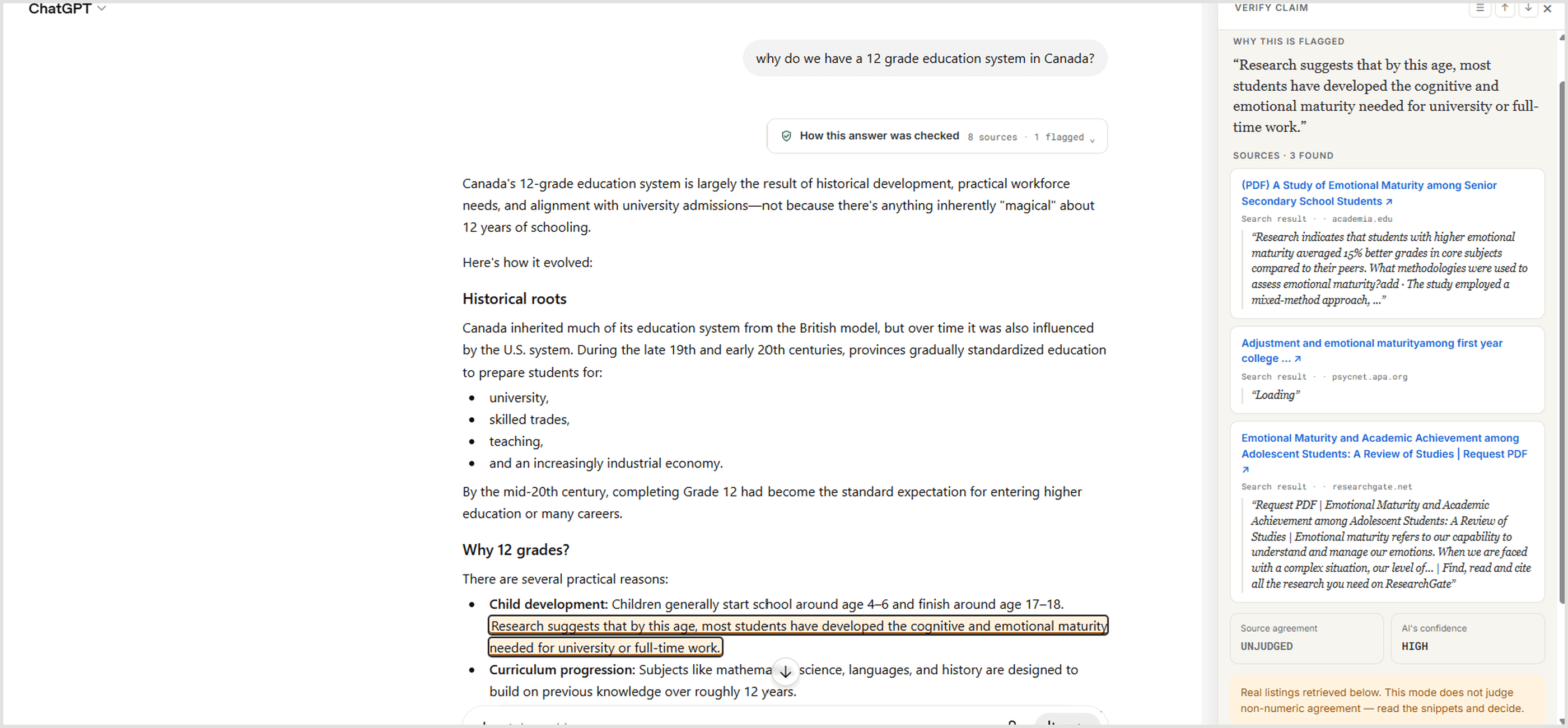
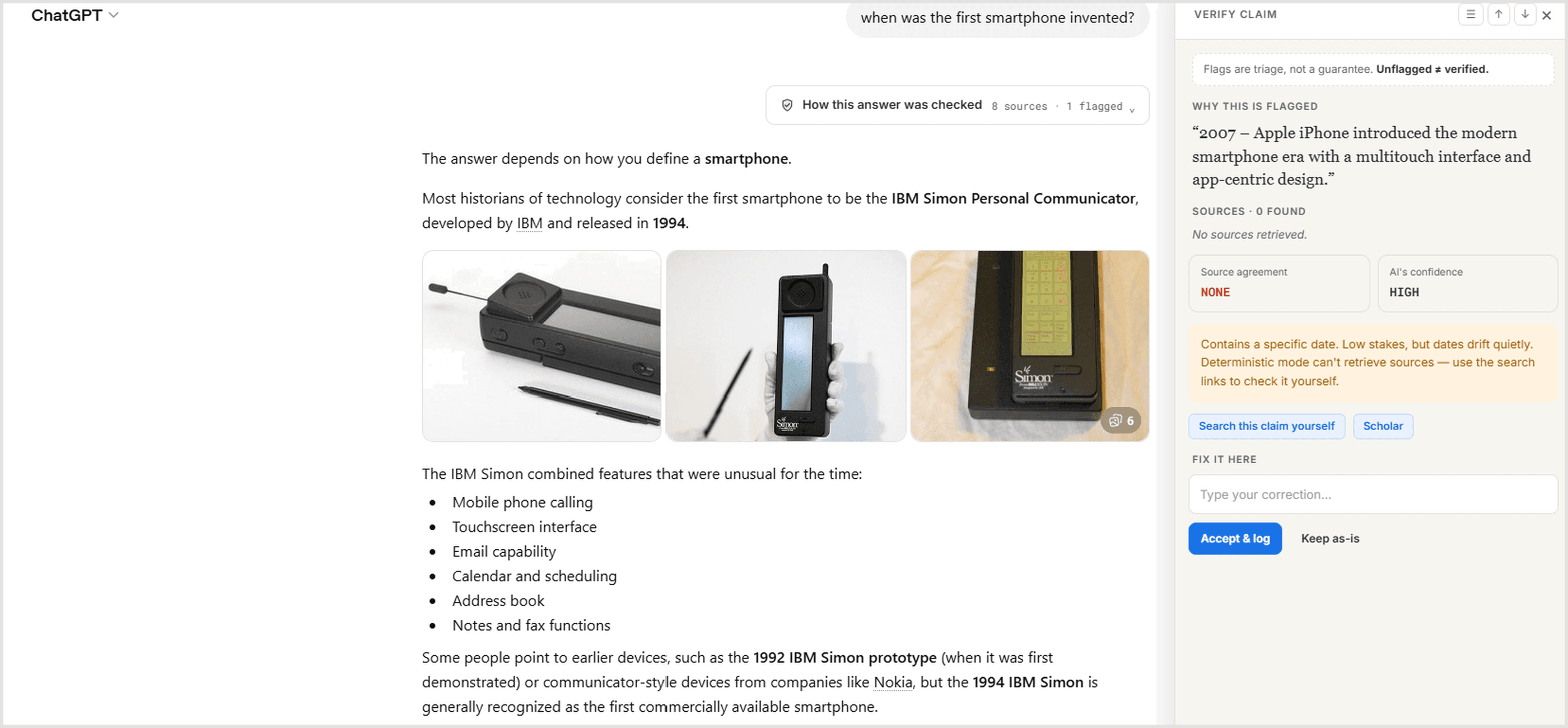
The tested prototype checked one scripted answer. The shipped version is a Chrome extension (v0.94) running on ChatGPT, Claude, and Gemini. It flags real claims, retrieves real sources with verbatim excerpts, and gates sign-off behind human judgment.
Building for reality raised a question the study never faced: can a verification tool built on AI escape the over-trust problem it exists to solve?
The answer became architecture: a trust ladder the reviewer chooses a rung on:
Bottom rung, fully deterministic. Pattern-based flagging, real search listings, claim figures checked against source figures by arithmetic. No generative AI in the loop. In testing, this mode caught an order-of-magnitude hallucination by pure number comparison.
Upper rung, AI-assisted. Reads sources and explains — labeled as fallible, and auditable: the interface shows the actual searches run and pages retrieved, from infrastructure records, not the model's self-description.
Finishing a review exports two files together. The corrected document and the verification trail. Stage 1 showed the workflow leaks at the very end: people rebuilt clean copies by hand and kept private records "to cover myself." So the export carries the result, not just the record.
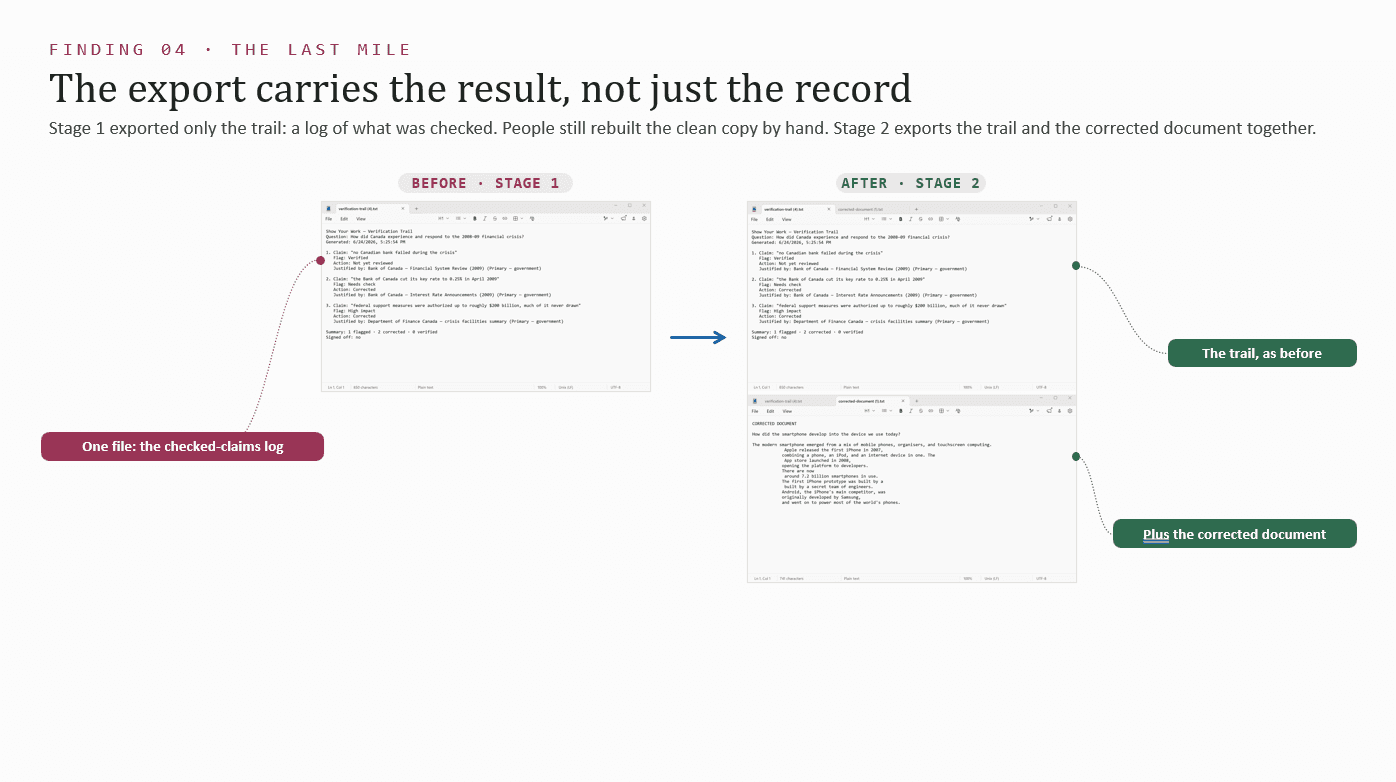
Stage 2's answer to the leak: the trail and the corrected document leave together.
What Twelve Sessions Can and Can't Tell You
They establish an effect and its direction, not its size in the wild. The workload finding wants a larger, more varied pool; the trust probe deserves a bigger sample before the flagging can claim to have earned trust rather than borrowed it.
And shipping taught me what testing couldn't: 3 defects reached the build that my own research methods later caught:
a drift from the researched flagging formula
a crash diagnosable only from console evidence
a toggle that broke only on second use.
Research isn't a phase that ends when building starts. It's the quality system the build runs on.
The Impact
Verification became measurably easier than vouching: a 45% and 44% reported workload reduction that survived a rebuilt interface and a new task.
And the project shipped. Show Your Work runs today as a live Chrome extension on Claude, Gemini, and ChatGPT, tracing AI-generated claims back to their sources.
What began as a question about trust ended as a working answer: people do not need to trust AI more or less. They need to see enough to trust their own judgment.